Tuesday, July 02, 2024

On the Harbor: BCYC’s Junior Sailors

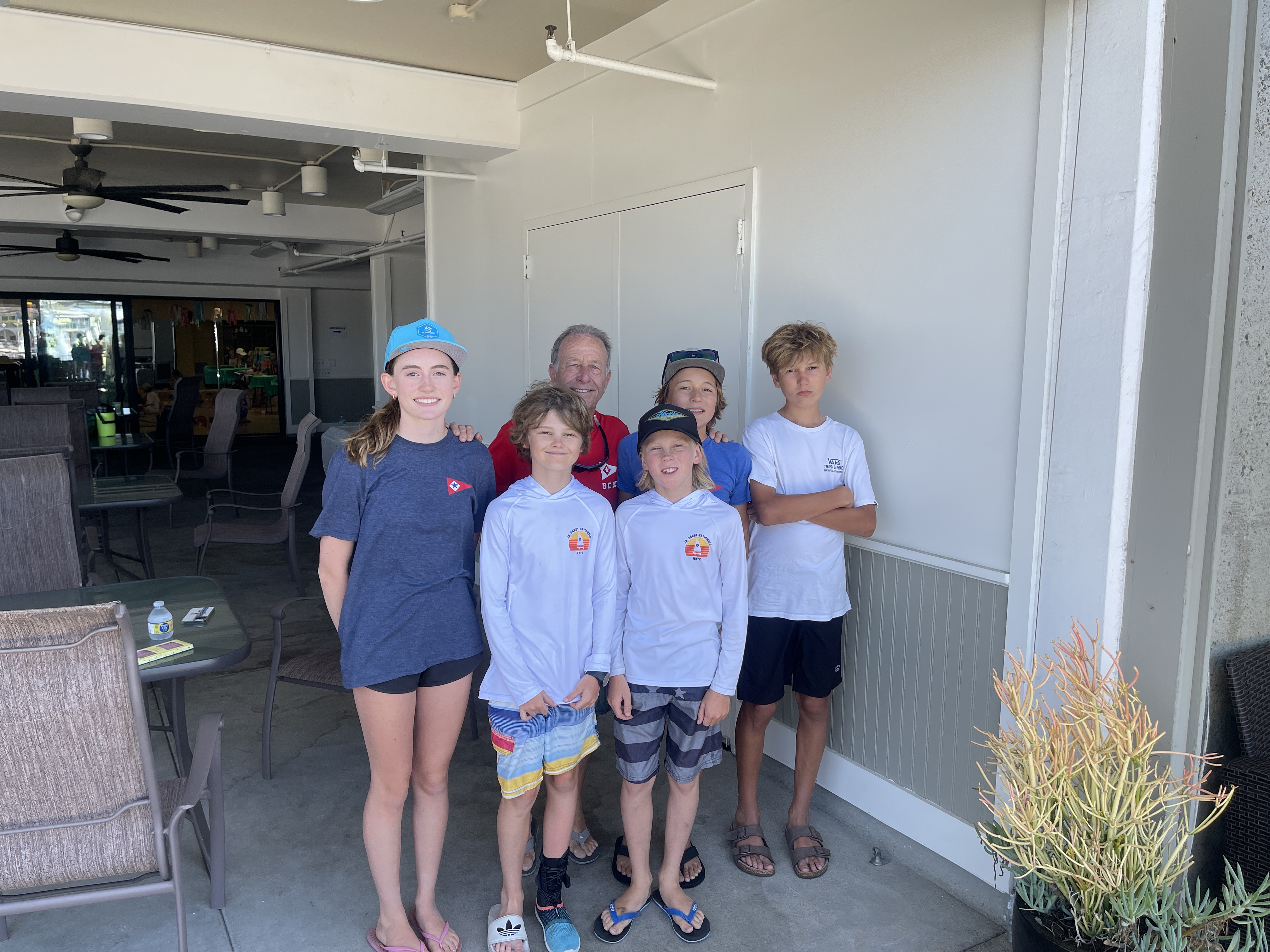
 (L-R) Front row: Emerson Shoemaker, Will Metzger and Tavin Beattie; Back row: Coach Mark Gaudio, Mesa Uliasz and Preston Decker

BY Len Bose


I had a chance last week to check in with several Junior Sailors from the BCYC sailing program. I’m not going to lie – each one of the sailors reminded me what I had forgotten and what I should be doing to improve my sailing performance.

Here are five quick interviews with some of the harbor’s newest yachtsmen.


Emerson Shoemaker – 13 years old

She has been with the BCYC program for six years, has owned two sabots, and is the first of her family to sail. She was introduced to sailing through family and friends. Shoemaker sails all year round and is also sailing in high school. She sails a Corsair sabot, whose name is Leeward Passage, with the same colors as Windward Passage. Before racing, she goes over her boat the night before removing any water and adding her weight to meet the boat class minimum weight rules.

“I am lucky enough to have some very nice Gresham (Marine) boards, and I like to keep them pristine and proper,” Shoemaker said. I asked her what she thinks about in the pre-start. “It’s pretty simple. I find it difficult to keep a long list in my head, so I check the angles off the starting line looking for the favored end, understand the time to sail the line, and try to get three or four pieces of information, so I am not going in completely clueless at the start.”

Mesa Uliasz – 13 years old

He has been in the program for eight years. “At 5 years old, my parents enrolled me into the Starfish program and I really liked it after a couple of seasons. My parents purchased a Phoenix sabot for me – sail number 9479.” I asked Uliasz how he comes up with a game plan. “I’m looking for pressure and looking for low-density areas on the racecourse. If I am sailing off of Lido, I’ll sail into a header a little longer to get into the Lido lift. With the dredging barge on the Lido corner, it gets a little light in there, so you don’t want to get too close. When sailing through the “bottleneck,” you do have to keep a heads up for the lefty coming through,” Uliasz said.

While sailing into the leeward gates my question to Uliasz was: “You are in second place, the first-place boat has a good lead on you with third place and fourth place within striking distance. It appears that the lead boat has chosen the favored mark, so what do you do?

“I’ll normally follow the leader because they are in phase, and I don’t want to gamble away my second place. Now if third and fourth place is well behind me I will consider the opposite gate the leader took, just in case a lucky shift comes through.”

Preston Decker – 13 years old

He has been in the BCYC program for four years and has a Corsair sabot, which he inherited from his older brother. “It’s one of the best sabots in the bay – it weighs 95 pounds,” Decker said. I asked how he got interested in sailing. “Mainly my brothers; I did not like sailing, to begin with, but I began to like it better just like my brothers did. Both of my brothers are world-class sailors.”

I then asked how he prepares for the start of the race and what goes through his head after the start. “Before the start, I look to decide which end of the starting line is favored, so I round the committee boat and then round the leeward end – whichever side I find has the best angle. I am always looking for a spot with a ton of space so I have room to accelerate. I like the port tack approach, looking for that space to start in. If my starting plan doesn’t work out, I tack looking for a lane to get back into phase with the wind. At the same time, I am working toward the favored side of the course.”

I next asked when he is rounding the weather mark and has the lead, what are his thoughts at this time. “When I am leading at the weather mark I can get rather stressed out and I have a tendency to over trim my sail which is a problem for me. I do my best to stay focused, not to mess up.” I asked the same question about rounding the leeward gates as I asked Uliasz. “I normally go to the opposite gate so that the leader can’t tack on me. I’m always looking for clean air.” My last question was what was he going to sail next. “I plan on sailing FJs and 420s like my brothers after I grow out of a sabot,” Decker said.

Will Metzger – 13 years old

He has been sailing in the program for three years. “My parents found the BCYC program during COVID because there was nothing else for us to do. I have a Corsair sabot, my third boat. I got it when I was a B sailor and the day I got it I moved up to As.” I asked Metzger how he preps for race days. “I like to sunscreen up, because I sunburn easily. I try to stay calm because once I am out there I don’t think, I don’t feel any pain I just kind of race. I try to remain calm because I do get nervous.” Then I asked if he ever feels like some days he has the mojo and when he doesn’t feel it what does he. “Most of the time I don’t feel it. I’m kind of in the middle. There are times when I feel I have it and there are times when I haven’t done that well in the previous regatta. But most of the time I feel like I am in the middle. I do tell myself that I am fast – I’m fast which builds my mojo up.”

I then asked Metzger about sailing in the five-point area of the harbor, and what are some of his do’s and don’ts. “Stay out of the moorings. That is like the number one rule, if you are starting in the south/west side of the harbor you want to start in the middle of the line and lead to the right. That Lido lift is crazy; you can gain another five to 10 degrees and lay the mark – it’s pretty good.” I asked about the current in that part of the harbor. “We do take current into consideration. I will luff my boat into the wind and see which way I am drifting,” Metzger said.

Tavin Beattie – 11 years old

He has been in BCYC program for five years with one of his younger brothers in the Starfish program. My first question was how does he came up with his game plan for the day as he looked up the course. “It’s important to look at the land and how it is shaped because the wind curves it. This creates the wind headers and lifts, and you want to sail in the lifts.” I then asked if he had a checklist for the day’s racing. “Making sure my weights are in the boat, paddle and bailer are tied down and I have my lifejacket on. If the wind is blowing eight knots you want to pull in the outhaul and make sure you have the foot of the sail a hand length from the boom,” Beattie said.

I then asked what his procedure is after rounding the weather mark. “Most of the kids like lifting up their leeboards to reduce drag. I feel jumping up to the front of the boat and rocking the boat slows the boat down.”

I asked Beattie after rounding the weather mark what he is looking at to decide if he wants to jibe or not. “Usually it’s decided on what the other racers jibe on. I want to sail on the jibe that takes you to the leeward side of the course.

Every time I do these interviews it makes me want to go sailing with these thoughts fresh in my mind. I should have written this story on Friday night rather than Sunday afternoon because I got beat up this Saturday sailing one of my RC boats. I think I will re-read this story before Taco Tuesday at BCYC this week.


Sea ya.

~~~~~~~~

Len Bose is a yachting enthusiast, yacht broker and harbor columnist for Stu News Newport.

Tuesday, June 18, 2024

On the Harbor: An interview with a storyteller


                                                           By LEN BOSE

I keep my Harbor 20 right next to where Jim Warmington Sr.’s home is, which is very close to the Newport Harbor Yacht Club. Over the last couple of years, I’ve said hello coming and going from my boat, with Warmington always giving me a very warm greeting and asking, “How was your sail today?” I always felt he really was interested in how the day’s racing went.

All of Warmington’s yachts are second to none; I’m always admiring them each time I travel by. While I was walking by one time it hit me – I needed to pick up the phone and ask Warmington for an interview. I wanted to learn about all his different boats, cruises, races and who he has sailed with over the years.

Warmington has named one of his yachts Shanakee III, which is defined as an Irish storyteller. And what an adventure he has to share!

Warmington was born in Los Angeles, and at the age of 13 his family moved to Newport Beach. The family would spend the summers at his grandfather’s beach house here. At the age of 8, Warmington crewed for Nancy Corkett on her Snowbird. When he was 10 years old, Santa left a Snowbird under the tree with Warmington sailing it for the next five years. He did quite well competitively, finishing a Flight of the Snowbirds in the top four one year, while always staying in the top 10. He won the “Gold S,” which means he won the class championships, which led him to win a couple of High Point trophies.

I asked him who were some of his top competitors, and he was quick to reply Burke Sawyer, Tom Frost and Craig Cadwalader. While participating on the USC sailing team, the team won the Pacific Coast Championships sailing Metcalf dinghies. The team also participated in the Kennedy Cup back in Annapolis at the Naval Academy, where the team made the podium. Warmington started sailing keelboats at the age of 17 aboard his father’s schooner, Nellie Bly.

“My father had entered the Ensenada Race and purchased a secondhand spinnaker,” said Warmington. “We won our class that year, and oh my gosh that was the happiest I had ever seen my dad.” That same year, he and his father Ed were invited aboard the 83-ft. schooner Sea Drifter, owned by Lyman Farwell with Tom Corkett aboard and 15 other crew members. “That was a big highlight for me at the time,” Warmington said.

“In 1960, my father had an L36 built in Costa Mesa that was our first new boat; we raced this boat a lot. Our family preferred going to Catalina most weekends; we always spent 10 days cruising around Catalina with two other families. We would stop in Avalon and the Isthmus to get ice. No showers. It was not the same as today with all the nice stuff we have on boats. But it was pretty great.”

He and his wife Vicki sailed snipes together for many years. “My first racing keelboat was a one-ton that was 35 ft. requiring a complete refit; from then on I did a lot of building, refurbishing and trading boats. I loved the racing and the cruising, but the projects were really important to me,” Warmington said.

Warmington started building custom boats, and one of his favorites was a motorsailer from Palmer Johnson that the family did some extensive cruising on. “I’ve always loved meeting with different naval architects designing boats, doing the tank testing, sitting down with the builders and going to the different boat yards. I’ve been to so many yards. I have only built a few of them (boats), but I have loved the process,” Warmington said.


Today, Warmington has a boat he had built by Nordlund Yachts –Shanakee III – which he refers to as a great big old playpen for family in Catalina and cruising in different areas. I call it a work of art; it has been my favorite power boat in the harbor for years.

Warmington also happens to own my favorite sailboat in the harbor named Teal, a 42-ft. daysailer built by Hinckley Yachts. “This is my favorite boat; everything is electric which allows me to run the boat from the cockpit, which makes it pretty easy to sail the boat short-handed,” Warmington said.

About 15 years ago, Warmington purchased an expedition boat with the idea that if he and the family were to go cruising he better get started. From day one, the boat has been enroute to the world’s best cruising grounds with stops in Alaska, Panama, Virgin Islands, Bahamas, Bermuda, Halifax, Maine, the East Coast, Galapagos and the South Pacific.

I asked where his favorite places in the world were to cruise. “The Adriatic Sea. The trip from Dubrovnik to Venice has hundreds of islands. This area is super awesome for cruising. The people are great, they speak English, the food is great, it’s wonderful for cruising – it’s the best.” For the sunny areas, cruising to the San Blas Islands are to die for. There are a couple hundred islands. It’s just a wonderful place,” Warmington said.

My next question was what was his most memorable race. The two TransPac races aboard a Swan 57 named Tigers and the 76-ft. Pedrick Shanakee II, with the crew John Cotton, Gary Hill, LJ Edgecomb, Carson Jefferson, Brad Avery, Robbie Vaughn, Grant Edgewater, Tad Springer and Ron Merickel. It was so fun – it’s the guys that made the trip. Those two boats were super seaworthy and great to be on. The guys were the best,” he said.

I then asked him to describe the perfect day in Catalina. “Having a couple of the grandkids and their parents over there with us, swimming, snorkeling, a BBQ on the beach on Moonstone, and hanging out together with my wife and me. That is perfect,” Warmington said. “My dad said on his last trip to Catalina there is no reason to go up there (heaven), because this is heaven right here. I kind of feel the same way. I have been to a lot of wonderful places and feel Catalina is tops; it’s the best,” he said.

With all this sea time, I asked if he could recall a time at sea when he was most challenged by the conditions or a situation? “My first TransPac race was very rough, but I was on a big boat; it got my attention. I had one race on my one-ton on the back side of Catalina; it was very stormy on my new boat. We did fine, but we had to be very careful. I also made sure we always had good crew aboard,” Warmington said.

My last question was to share his words of advice on being a proper yachtsman. “Being knowledgeable about boats and respectful to the sea is super important; always be safety conscious – update your inflatable life rafts, have the proper life jackets and be super cognitive of how to properly run a yacht,” he said.

Now that’s a story I can listen to again and again. Jim – I’m just minutes away if you need any crew for a daysail aboard Teal.

Sea ya.

~~~~~~~~

Len Bose is a yachting enthusiast, yacht broker and harbor columnist for Stu News Newport.

Tuesday, June 04, 2024

On the Harbor: Checking out the shipyards


By LEN BOSE

On your marks, get set…it feels like we are in that long pause before Go – summer is here. Twilight sailing has started, and the yacht clubs’ opening days have passed, while everyone is still stuck at the starting gate. I took a quick walk through our shipyards this week just to get a pulse on the harbor.

I started at Newport Harbor Shipyard and as always the big boats grabbed my eye, when I noticed the large blue stern of a sailboat sticking out of the paint tent. I could still make out the previous name of the boat – Chessie Racing. She was designed by Bill Tripp to be daysailed with a small crew along with the performance for occasional distance races. She is 62 feet overall with a draft of 13’4,” and yes she has the ability to reduce her draft to 7’8” to enter our harbor.

Everything about this boat illustrates perfection with teak decks, carbon hull, huge sail plan with boom furling main, hydraulic and electrical systems that provide push-button power to every winch, and sail control. She is rumored to be owned by a member of the Newport Harbor Yacht Club. What a sight when this boat lines up with Hasso Plattner’s Reichel/Pugh 68’ Claude during Long Point Race Week. After standing there looking at her, I finally awoke and continued my walk through the yard. Maybe because it was a Monday morning the activity looked a little light for this time of year.

 Looking across the harbor over at Balboa Shipyard and South Coast again looked slow, so I got back in my car and headed over to Basin Marine Shipyard. While driving down PCH, I glanced over at Larson Shipyard with no activity at all. They must be in transition into new management, or they are coming up with using that property differently. The Duffy boatyard is next and as expected, busy as always. If you need a quick haul out for a simple fix or inspection, keep the Duffy yard in mind, as their travel lift can lift up to most 55-ft. boats. Arriving at Basin Marine Shipyard there is a boat there I would guess is a Jarvis/Newman 42, some type of lobster boat that has been going through a complete restoration. She is leaning toward fishing, and she is sweet!

Looking out at the harbor, I noticed the new Grand Banks/Eastbay 44 leaving the boatyard. This new line has been out for more than five years, and I am now just noticing it. She is designed by Ray Hunt which is why I had a double-take. The recent Hunt designs are perfect for our use in Catalina. If I am ever so fortunate to own this boat I would have to name it Dream On.

Another all-time favorite yacht of mine is the 65’ Halmatic Silver Oak, which traded hands at the end of April. She is now berthed in a private slip near the turning basin. I’m very pleased to see that she is staying in our harbor.

My feel-good moment came after holding my own in the NHYC summer Twilights on Thursday night (May 23), sailing my Harbor 20. While pulling up to the bar in the Pirates Den at NHYC, David Team came up and offered to buy me a drink, and after a short while, his wife Kyle came up and I introduced myself. Kyle said, “Oh Len Bose from Stu News Newport – I look forward to your articles as I’m a big fan.” Nothing like a pretty lady giving you a compliment to end your day. Thank you again for the cocktails Dave; that was very kind of you and the next two rounds are on me.

Well, I am off to Foster City for the IOM (remote control boats) Nationals. I will be getting my nose rubbed into it, yet it always comes down to tiller time. Please wish me luck, as will need it.

Sea ya.

~~~~~~~~

Len Bose is a yachting enthusiast, yacht broker and harbor columnist for Stu News Newport.

Tuesday, May 21, 2024

On the Harbor: a round-up of public piers

 The new Balboa Marina Public Pier


By LEN BOSE

I have been keeping an eye on our public docks, so I wanted to share a round-up with you.


–Balboa Marina Public Pier

Fifty-foot yachts can tie up at this public pier with plenty of space. The only restaurants are SOL and Tavern House, which are a short walk away. The previous guest slips that are just in the back of SOL have been returned to rental with no access. This is a No Fishing dock, and it’s challenging to maneuver your vessel into these slips with strong currents and a cross breeze. There is also a large amount of vessel traffic in this area. Note that there are two rental side ties for Duffys on the southeast corner of the dock. My observation is the harbor will need to grow into the area should the Bayside Village be redeveloped.

–Balboa “Little Island,” Balboa Avenue

I never knew this dock/ramp in the Grand Channel existed. It’s only good for Whalers, small inflatable boats and SUP boards. You must pull your boat onto the sand and anchor/tie down. Odds are good you will get your feet wet, although there is great access to Marine Avenue on Balboa Island.

–Park Avenue “Little Island”

This dock will also give you access to Marine Avenue on Balboa Island. There is a public restroom next to the fire station. Public restrooms are open from 6 a.m.-10 p.m. in Newport Beach. One of my favorite bars – The Village Inn – is within stumbling distance. This is a very active fishing dock, so working your way into the dock will be challenging.


–Coral Public Pier, Balboa Island

This is very clean; the fishing dock has a good amount of mooring traffic. Mooring traffic is where people tie-up for short stays and then return to their moorings. This pier is a short walk to Marine Avenue and the Village Inn. There is enough room for two Duffys. Fishing is restricted between 10 p.m. and 6 a.m. on the public docks, although it has to be a challenging task to enforce. I have heard that Harbor Code enforcement does random night patrols.

–Sapphire Public Pier “North Bay Front,” Balboa Island

This is clean and also has a fishing dock, just five blocks from Marine Avenue. Keep this dock in mind when your destination is the Village Inn. Should you wish to extend your walk over the Balboa Bridge, the Bayside Restaurant is close by and worth the walk. My guess is that the mooring traffic is light at this location and will offer you the best odds of finding an open spot.

–Opal Avenue Public Pier, Balboa Island

This is located next to the Ferry Landing and Island Marine Fuel – a fishing dock, clean with public bathrooms. You are within walking distance of Todos Santos restaurant, serving modern authentic Mexican food. If you consider the difficulty of parking your car on the Island, the odds of finding a parking place on the public dock for your Duffy seem much higher.

–Emerald Ave Public Pier “North Bay Front,” Balboa Island

This is a clean fishing dock, and still a short walk to Todos Santos, or you can take a walk around the Island. I would guess this dock has little to no traffic on it.


- Lido Public Pier "Lido Village".

One of our newest public piers is very clean, with small boats only, no fishing, and access to Lido Villiage, Elks Club, and West Marine. When this pier was in the concept stage it was described as a perfect location for yachtsmen to anchor their large boats in the turning basin and then come ashore. That is exactly what I witnessed while inspecting the public piers. Keep this pier in mind during the next boat show.

–Rhine Wharf Public Pier

This is located on Lido Park Drive between the Cannery and Bluewater Grill. Both of these restaurants have docks, so the odds of finding an open spot to dine are very strong. It is a short walk from some of my favorite restaurants: Arc Butcher & Baker and The Dock. The Helmsman Ale House is in the area, and 40-ft. yachts can tie up. No fishing is allowed.

–Lafayette Public Pier

This is located at 2900 Lafayette Ave. and has been one of the best-kept public pier secrets. In fact, it’s not even on the chart yet. It’s just being refitted and installed this month. It offers everything the Rhine Wharf does and it is all brand new.

–19th Street Public Pier

This has a new public restroom, heavy mooring traffic, and the dock is clean with no fishing. Forty-foot yachts can tie up here. You are within walking distance of the Newport Beach Pier, so if you are like many of my friends who go to Blackie’s on Friday night, this is the public dock for your Duffy.

–15th Street Public Pier

Expect heavy mooring traffic here along with fishing. The American Legion is next to this pier. You are still in walking distance of Newport Pier, or you can go to church across Balboa Boulevard at Our Lady of Mount Carmel. I am hoping my friends on the Harbor Commission will consider this location for some dinghy rack storage for offshore mooring permit holders. Without a doubt, this is the most heavily used public pier on the harbor.

–Fernando Street Public Pier

This is a short walk to The Fun Zone, the Balboa Saloon, and the Class of 47. There is heavy mooring traffic, it’s clean and it’s a fishing dock. There is a boat waste pump-out station, and this is also a good place for dinghy racks.

–Washington Street Public Pier

Located in the middle of the Fun Zone with public restrooms, a fishing dock, and heavy traffic, you would be fortunate to find a spot to tie-up. Everything is here – pizza places, ice cream, the Newport Landing restaurant, and a liquor store. Across Balboa Boulevard is a wine store, Cruisers Restaurant, and a great Mexican restaurant.

–M Street Public Pier

Located at the end of the Peninsula at 2144 Channel Road. This is one of the most actively fished public docks in the harbor. Don’t even think about tying up here – leave this pier to the fishermen.


Our Harbormaster Paul Blank and his team are doing an outstanding job keeping the public piers clean and enforcing the dinghy time limits. In past years, I recall pure anarchy on the public docks. Now they are clean, safe, and very accessible. If you are trying to access a public pier and the fishermen just refuse to make room for you to tie up, you can always give the Harbor Department a call to assist you.


Sea ya.

~~~~~~~~

Len Bose is a yachting enthusiast, yacht broker, and harbor columnist for Stu News Newport.

Friday, May 03, 2024

On the Harbor: NHYC’s Opening Day and a bit about flag etiquette


By Len Bose


This Saturday (May 4), is the Newport Harbor Yacht Club’s Opening Day race followed by the club’s Opening Day on Sunday (May 5). On May 15, the Newport Harbor Foundation is throwing the First Annual State of the Bay Luncheon at Newport Harbor Yacht Club. Guest speakers will be Seymour Beek updating you on the ferry status, Harbormaster Paul Blank updating you with his report, Bill Kenney will be reviewing mooring fields-reconfiguration and rates, and Duffy Duffield will be updating you on the water wheel and dredging projects. All are very important and interesting topics. For more information or to RSVP, contact Julie Ackman at julie@julieackman.com.

Newport Harbor Yacht Club’s Opening Day Race is one of the best-attended races of the year, with boats in the 23- to 76-foot range. The race starts up in Long Beach Harbor out the Long Beach entrance, then finishes at the Newport Pier. This race is a pursuit race where the little boats start to their handicaps rating to the fastest boats. So, if the fastest boat owes two hours of handicap time to the slowest boat, that’s when the slower boats start. It does make for some fun sailing with the day being more about a sail down the coast than racing.

Many of my favorite boats have entered this year Venture, Craig Atkins’ 76’ Pedrick; Teal, Jim Warmington’s 42’ Hinkley and Rocket, the Fuller Family Santa Cruz 50. The usual favorites to win are Doubletime, Molly and Alan Andrews’ Andrews 38 or Lone Ranger, Kayla La Dow’s Ranger 33. As always, the weather will play a big part in this race. The forecast is for a light breeze out of the south in the late morning then a rather strong westerly breeze will be filling in, so I am going to place my money on a big boat and go with the David Team aboard Peligroso, the 68’ Kernan. It’s always a great day on the water and the perfect way to lead into a yacht club’s opening day. Newport Harbor Yacht Club Opening Day is second to none in our harbor with the usual boat inspections, ceremonies, and celebration of the opening of the boating season.

 Seventeen years ago I wrote a story called “The True Yachtsman Guide To Flag Etiquette for Opening Day.” Some 7,000 people have read this story. If you are interested, you can find the story on my blog site at http://lenboseyachts.blogspot.com/. I am a big fan of having one’s own private signal – usually a tapered, swallowtail pennant, but sometimes a rectangle or triangle. The tradition of the private signal, or “house flag” currently used dates back to the 18th and 19th centuries, when the sailing ship lines were at their peak. Many line owners were yachtsmen and carried their “house flags” that have been passed down for generations. If a member doesn’t have a private signal, one is recommended that is both simple and timeless in design and easily recognized from a distance to ensure its continued use for future generations. Traditionally, initials were not used. The tradition for more than the past 100 years in yachting is that the club (association) burgee be displayed on the bow staff or the truck using a staff or “pig stick.” The reason for these locations is for maximum visibility under sail, as well as at anchor.

In recent years, yacht clubs have opted for the starboard spreader as an alternative location for the burgee to accommodate yachts whose trucks are encumbered with wind indicators and electronic gear. However, the burgee must be hoisted to the spreader (or “two-blocked”). Other flags may be hosted beneath the club burgee in the following order: Association burgee (if a yacht club burgee is also being flown, officer’s flag, owner’s flag, and other message flags. Yachts at anchor must display the ensign on a staff placed in a socket located on the starboard stern rail or pulpit as close to the centerline as feasible.

Most people re-read this piece to recap the order of code flags for dressing a ship. On the fourth of July and other special occasions, yachts may dress a ship when at anchor. The International Code Flags are displayed from the waterline forward to the waterline aft, using weights at the end in the following order arranged to the effect color patterns throughout, starting forward: AB2 UJ1, KE3, GH6, LV5, FL4, DM7, PO 3rd repeater, RN 1st repeater, ST0, CX9, WQ8, ZY 2nd repeater. This is just a suggested order of the code flags, but good luck telling your club’s inspections committee that there is no real prescribed order. With few exceptions, vessels shall make colors only between the hours of 0800 and sunset. All colors should be struck at sundown, which includes yacht club burgees, fun flags, fish catch flags, code flags for dressing ships, etc.


Sea ya.

~~~~~~~~

Len Bose is a yachting enthusiast, yacht broker and harbor columnist for Stu News Newport.

Wednesday, May 01, 2024

The Harbor Report: My meeting with two boat-making legends


        s. 


While walking the docks this week, I learned that quality produces quantity.
As I was showing a boat, I was introduced to one of my prospect's friends, Mike Howarth. As our conversation progressed, I quickly learned that Mike knew a whole lot more about boats than I did.
So, rather than proceed with my introduction, I got quiet and listened. Mike had been building boats in California since the early 1970s and has owned Pacific Seacraft and Cabo Yachts.
Two days later, I called Mike and asked him for an interview.
"OK. Sure, Len," he replied. "I should call my partner Henry Morschladt. We have worked together from the beginning, and he has a shop across the street from me."
When I met Mike, Henry was pulling into the parking lot. Mike started to talk about his boat-building career. Mike's passion for working with wood brought him to Harbor Yachts, where he became the foreman in the woodshop.
His next job was with Islander Yachts, where he moved over to the fiberglass tooling department, which relocated from Costa Mesa to Santa Ana. One day a number of boat molds showed up next door where Pacific Trawler started building boats.
Mike then moved to Pacific Trawler and was doing woodwork and engine installation. That's when he met Henry Morschladt, who was its engineer, purchasing agent, and part-time sales guy. Henry showed Mike one of his designs of a 25 cruising sailboat. It later became the Pacific Seacraft 25, and the two of them started building it.
As they came to the completion of that first boat, they needed to sell it and have it ready for the upcoming boat show in Newport Beach in the spring of 1976.
"I remember Duncan McIntosh really getting upset with us because he had never seen anyone bring a bandsaw down to the docks, before the show, in order to complete the boat in time," Henry said. "We had called in every favor and had all our relatives down on the docks, sanding and helping us finish the boat before the show started."


Henry sold the boat at the show, and the team went on to build 275, 25-foot boats. They had opened shop at an old Dr Pepper bottling company building in Fullerton and started Pacific Seacraft. One day, without telling them, Fortune Magazine wrote that they were building one of the top 100 products in the world.
This led to the team building thousands of boats from 20 to 37 feet, and becoming one of our country's top boat manufacturers. In 1988, they completed the sale of the company to a group out of Singapore.


By 1990 both Henry and Mike started talking about building another boat again and focused in on a 35-foot sports fisher.
"If we had been smarter, or shown any form of intelligence, we would have thought it to be crazy to go out to the High Desert and start a boat company," Mike explained.
But that's what the two of them did. And, under a small shed, they worked their magic again and completed their first boat just before the Long Beach boat show in the fall of 1991.
"On a Friday, I was calling the five or six people we had working with us, and told them that we would have to stop working until we sold the first boat," Mike recalled. "That weekend we sold the boat, and on Sunday I was calling everyone to come back to work on Monday."
Within five years the guys had started Cabo Yachts, in Adelanto, and were producing more than 120 boats a year, from 31-footers to 47-footers, with 400 employees. Again, the duo raised the bar and produced the highest quality sportfishing boat in the world, following it up with a "hassle-free warranty" that kept their customers coming back. In 2006, the guys sold the business to Brunswick.
Will Henry and Mike return to the boat-building business?
"I always am looking around," Mike said.
These guys are very smart. They were not going to tell me anything about what they were up to. I am just glad they did what they did and hope for the future that they return.
If any of my readers would like to meet me, at 1:30 p.m. on April 25 I will be at the OASIS Senior Center, 801 Narcissus Ave., Corona del Mar, speaking about our harbor's beer can races. Hope to see you there.
Sea ya!
LEN BOSE is an experienced boater, yacht broker and boating columnist.

FLASHBACK: The True Yachtsman Guide To Flag Etiquette for Opening Day

I wrote this story in 2007:


According to naval regulations, a flag officer is anyone who holds the rank of rear admiral and higher. Applying that reasoning to yacht clubs, only the commodore, vice commodore and the rear commodore have a clear claim to the title of flag officer. A past commodore has less of a claim, and a fleet captain, secretary and treasurer have no real claim at all.
Yachting and Customs and courtesies by Joseph Tringali.

When two boats are approaching the same gangway or landing stage, flag officers shall have the right of way in order of seniority.

Piloting seamanship and small boat handling “Chapman’s”


Distress: Though not official, flying the US Ensign upside down is universally recognized as a distress signal.


Transportation: Code flag “T” is used to call the club tender.

When cruising away from home waters, the wise yachtsman keeps a sharp eye out for local customs. It is a mark of courtesy to conform to local procedures and practices. While visiting at a yacht club of which you are not a member, observe the actions and routines of the local owner-members, and particularly the club officers. This is especially important with the respect to evening colors. Not all clubs strictly calculate the daily time of sunset, and some may be earlier than you would normally expect. If you will be off your boat at the time of evening colors be sure to take down your flags before you leave your boat.


SHIPS BELLS:
That pesky clock which no one ever seems fully to understand is based on the concept of watches: not wristwatches, but ship’s watches. The ship’s day is divided into six four-hour ‘watches’ beginning with the period from 8:00 P.M. to midnight, which is called the ‘first watch’. For the record, the names of the watches are:
8:00 Pm to midnight First watch
Midnight to 4 AM Midnight Watch 135
4:00 am to 8:00 Morning Watch
8:00 am to Noon Forenoon Watch
Noon to 4:00 pm Afternoon Watch
4:00 pm to 8:00pm Evening watch

Now for the bells: A junior member of the crew, usually a cabin boy, was assigned to the task of keeping track of the length of the ‘watch’ by turning a sand-filled hour glass and to make this just a little more complicated, the glass needed to be turned every thirty minutes. The boy was ordered to ring the bell once for each time he turned the glass. Thus, one bell repents 8:30pm two bells 9:00 pm, three bells 9:30. Etc. At eight bells, four hours, the watch changed, and a new cabin boy took over, ringing the bell once at thirty minutes after beginning of his watch and continuing as described through the entire four-hour period.

Absolute purists will note the 4:00 pm to 8:00 pm evening watch is usually dived into two ‘dogs’ known as the ‘first dog’ watch, from 4:00 PM to 6:00 pm and the second ‘dog watch”, from 6:00 pm to 8:00 pm. The word ‘dog’ in this instance has nothing to do with a four-legged canine; rather, it is ‘dog’ in archaic sense that we might today use the word ‘jog’ or ‘skip’. ‘ Dogging’ the watch allowed the crew to eat their evening meal, which generally was the only full meal of the day, between the hours of 4:00 pm and 8:00 pm. One-half of the crew was at the table while the other half was at work. No special arrangement is made for the bells during the dogged watch: they continue as before, adding one bell every half hour until the watch ends at 8:00 pm
One final note on ship’s bell is recorded by Lieutenant Commander Lovette and provides an interesting idea for yacht club New Year’s Eve party:
An old custom, once strictly observed, was that of having the oldest man in the ship, be he the admiral or jack-of-the-dust, strike eight bells at midnight, on December thirty-first. This was immediately followed by eight bells for the New Year and always struck by the youngest boy on board. It was, of course, the only time of the year when sixteen bells were struck.

Piloting seamanship and small boat handling “Chapman’s”
Yachting and Customs and courtesies by Joseph Tringali.
Yachting Protocol Guidelines by SCYA


Most yacht clubs have an area set aside as a memorial for the club’s past commodores. Regardless of the form it takes, the purpose of the past commodore’s memorial is something more than feeding the egos of the select few by recognizing a group of individuals whom most people remember vaguely and whom new members may know not at all. It is in the nature of a yacht club to maintain a closer tie to its roots than almost any other kind of club. The memorial, past picture books, photographs, is a continuing link with the club’s past. It is one of the many traditions, which make a yacht club unique

In the past I have noticed visiting yacht club with more than half of the participants flying the wrong flags in the wrong places. Yacht clubs should also ask the visiting club’s to bring their flag so that we can fly the visiting clubs flag. Proper flag etiquette shows other clubs and yachtsman just what your club is all about. Final words, Flags are not flown for appearance; they convey definite and well-accepted meaning. There may be some debate on whether or when a particular flag should be flown, the byword must always be, “ Less is more”


Flag Time
With few exceptions vessels shall make colors only between the hours of 0800 and sunset. All colors should be struck at sundown, which includes yacht club burgees, fun flags, fish catch flags, code flags for dressing ship, etc. For our opening day chairs, all boats displaying colors, private signals, code flags, etc before 0800 on opening day should be noted and assumed that all colors were flown overnight.

Private Signal: The owner of the vessel designs a flag. Usually a tapered, swallowtail pennant, but sometimes a rectangle or triangle. The tradition of the private pennant signal, or "house flag," currently used dates back to the 18th and 19th century when the sailing ship lines were at their peak. Many line owners were yachtsmen and carried their "house flags" to their yachts. Many members of the older yacht clubs have "house flags" that have been passed down for generations. It is flown in place of the yacht club burgee, from the bow staff on mast less yachts, or from the top of the mainmast on sailing vessels. On todays racing yachts they are flown under the yacht club burgee on the starboard side. Many private signals, particularly those of recent vintage, show symbols which are particularly related to the owners life; someone in computers might be distinguished by a cursor, for example; while others a play on words: the name "Seals" could be represented by a seal or a sun rising.


It is accepted practice that never more than one private signal is displayed at a time.
If a member does not have a private signal, one is recommended that is both simple and timeless in design and easily recognized from a distance to insure its continued use for future generations. Traditionally, initials were not used. May be flown by day only or day and night.


Bose Private Signal


FLAG INVENTORY

All true yachtsmen should have on board an inventory of the proper flags and signals. The following is a list of suggested flags.

ENSIGN (mandatory)
Congress established the Yacht Ensign of 13 stars encircling an anchor in 1849. Also, the national colors (traditional Stars and Stripes) may be displayed in lieu of the ensign, particularly in foreign waters.

UNION JACK (optional)
A rectangular of the union of 50 stars on a blue field.

YACHT CLUB BURGEE (mandatory)
Usually a triangular or swallow – tailed pennant, which represents the owner’s yacht club.

ASSOCIATION BURGEE (mandatory)
The Catalina Conservancy Burgee may be flown in place of the yacht club burgee or beneath a yacht club burgee. The design of the Association’s Burgee was created in 1996.

OFFICERS Flags (mandatory)
A rectangular flag which represents the rank of the yacht club or association officer. Four flags are generally recognized in yacht clubs: Commodore, Vice Commodore, Rear Commodore, and Fleet Captain.

The Commodore’s Flag consists of a field of dark blue with white fouled anchor surrounded by thirteen white stars.


The Vice Commodore’s Flag consists of a field of red with white stars with a fouled anchor surrounded by thirteen white stars.

The Rear Commodore’s flag consists of a field of white stars with a red stars with a fouled anchor.

The Fleet Captain’s flag consists of a field of white with a dark blue fouled anchor.


PRIVATE SIGNAL (recommended)
Usually a tapered, swallowtail pennant, but sometimes a rectangle or triangle. The tradition of the private signal, or “house flag” currently used dates back to the 18th and 19th century when the sailing ship lines were at their peak. Many line owners were yachtsman and carried their “house flags” that have been passed down for generations. If a member does not have a private signal, one is recommended that both simple and timeless in design and easily recognized from a distance to insure its continued use for the future generations. Traditionally, initials were not used.

OTHER SIGNALS
Owners Absent (recommend): A dark blue rectangular signal. When hoisted, it can often save the frustration of rowing across the cove or harbor only to find the owner has gone ashore.

Owners Absent (recommended): A rectangular dark blue signal with a white diagonal stripe starting from the upper corner at the hoist.

Owners at Meal (optional): A white rectangular flag for those who care to dine understand. Also so known as a do not disturb sign.

Crews Meal ( optional) A red rectangular flag for that crew who care to dine understand. This is one of the only signals flown on the port side.

International Code Flags (optional)
A set of these signals is both practical for cruising and necessary for dressing ship. May be displayed for signaling using the “International code of Signals” for definition of the codes.


Racing Pennant (optional)
A distinctive pennant has been designed by the Sea Cliff (N.Y.) Yacht Club as an identifying signal for racing boats. The field is blue, with white fluorescent strip in the middle, and red anchor superimposed.


ROUTINE
The tradition for over the past 100 years in yachting is that the Club (Association) Burgee be displayed on the bow staff or the truck using a staff or “pig stick.” The reason for these locations is for maximum visibility under sail, as well as at anchor.
In recent years, yacht clubs have opted the starboard spreader as an alternative location for the Burgee to accommodate yachts whose trucks are encumbered with wind indicators and electronic gear. However, the Burgee must be hoisted to the spreader (or “two-blocked”). Other flags may be hosted beneath the club Burgee, in the following order: Association Burgee (if a yacht club Burgee is also being flown, Officer’s flag, owners Flag, other message flags. Yachts at anchor must display the Ensign on a staff placed in a socket located on the starboard stern rail or pulpit as close to the centerline as feasible.

SIZE OF FLAGES
All flags should be of proper size for recognition and identification.
YACHT ENSIGN OR NATIONAL COLORS.
The fly (horizontal direction) shall be a Minimum of one inch per foot of overall length of overall length of the yacht, with the hoist (vertical direction) equal to two-thirds of the fly. Length overall should include bow platforms for the better proportions.

BURGEE, PRIVATE SIGNAL, OWNER ABSENT, OWNER AT MEAL, GUEST, CREW AT MEAL AND INTERNATIONAL CODE FLAGS. The fly shall be a minimum of one-half- inch per foot of the height of the highest truck, measured from the waterline, and with the hoist two-thirds of the fly.


DRESSING SHIP
On the forth of July and other special occasions, yachts may dress ship when at anchor. The international Code Flags are displayed from the waterline forward to the waterline aft, using weights at the end in the following order arranged to the effect color patterns throughout: Starting forward:AB2 UJ1, KE3, GH6, LV5, FL4, DM7, PO 3rd repeater, RN 1st repeater, ST0, CX9, WQ8, ZY 2nd repeater.


NOW that you have read this what the hell do you do with this information? Keep this site bookmarked and refer back. Purchase the listed flags for the yachtsman that has everything. Show everyone next season that you’re a true yachtsman and take the time to fly the proper signals.